How an onboarding prototype proved positive indications of retention
Successful onboarding is more than just a good start—it’s the key to long term retention. Thoughtful, a seed stage start-up, launched their product to withstand the risk of churn by testing and iterating onboarding before development.
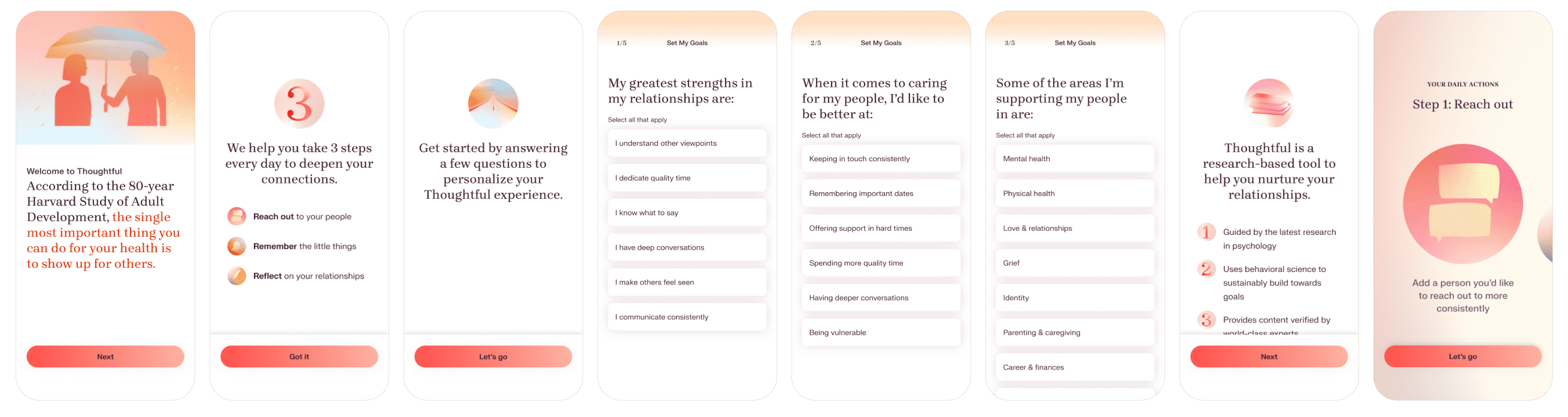
A sequence of steps from the onboarding flow designed to gain trust and engage users with prompts that encourage self-reflection.
Research
Coming right out of the COVID19 pandemic in 2021, we surveyed and interviewed potential consumers on the effects that social distancing had on their relationships. This is what we discovered:
The Voice of the Consumer research revealed a strong desire for a supportive community. People realized their circle of support (where they needed support), was smaller than they had originally thought.
When relationships fall by the wayside It feels like an intense chore rather than a spark of joy to reach out.
The one obstacle preventing people from initiating communication with their loved ones, particularly during challenging times, is the uncertainty of what to say.
Early on, a cohort of ‘Enthusiasts’ (our primary target persona) voiced that they were time poor and didn't have the energy to keep up with their social circles. The distance in their relationships with their loved ones grew both figuratively and literally. For me, it felt like a gargantuan job to stay on top of all the details that mattered for everyone that mattered.
Remembering important recurring days, such as birthdays and anniversaries was a high value, low effort way to stay in touch. These dates have emotional weight and we often don't put it on our personal calendars. Doctor visits and surgeries are other examples of this type of important day.
The pain points were insightful in their patterns and priorities but it wasn't enough to define the opportunity. There were risks to handling personal and sensitive information.
An expert panel of psychiatrists was consulted for the purpose of employing responsible methods and measures. Those at Weil Cornell introduced us to Cognitive Behavioral Therapy as a possible competitive advantage to leverage when designing for behavioral change.
Better Social Habits
How might we help users take small steps to improve their perception of their circle of support?
Empowering Connection
How might we evoke the feelings of ease, safety and joy to set the mood for relationship building?
Expert Guides
How might we provide the knowledge to speak with confidence on the user’s intentions to connect?
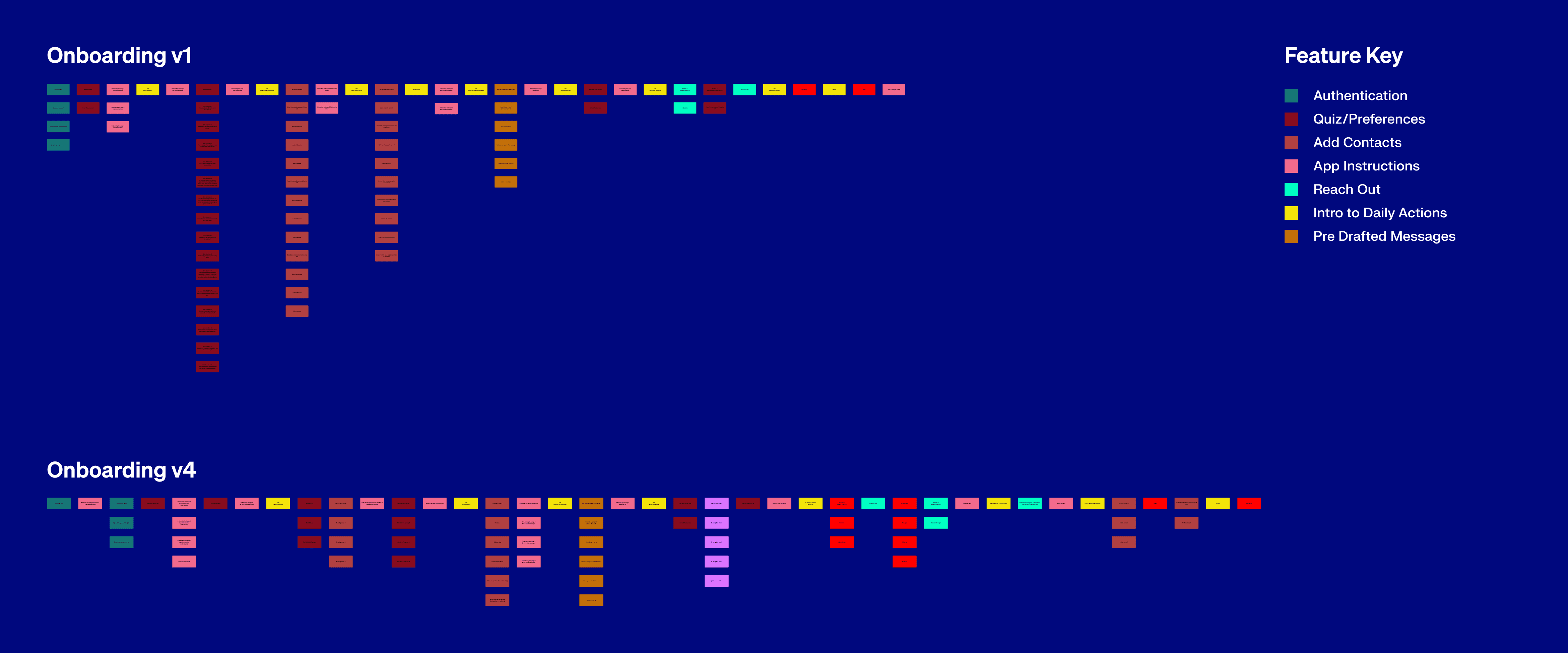
The above diagram is an example of how the human centered design process affected the onboarding narrative over 4 iterations.
Ideation
We hypothesized that depth in task flows would keep users focused and make for a better onboarding process. What we observed was the opposite.
Introspective activities, those that make you think, such as preference selection and profile building are ones that had the potential to bring the most value to the business and the user. They were also harder for the user to complete because it required a lot of 'work' to input that information.
Front loading the onboarding experience with heavy tasks was off putting as users didn't fully understand the value of the app yet. To them, it wasn't a fair trade off to divulge so much information without having their full commitment.
The onboarding process needed to strike a balance between storytelling and data capture. What we discovered was that an overly structured onboarding didn't work as well
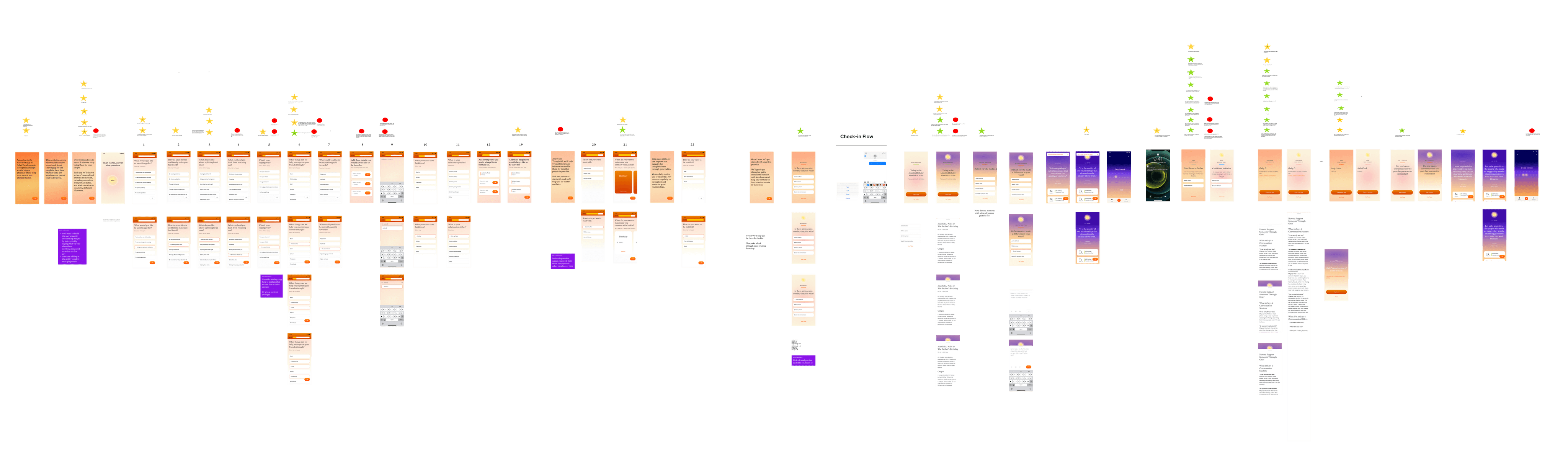
The above diagram is an example of how the human centered design process affected the onboarding narrative over 4 iterations.
What were the moments that mattered? Trcaking the sentiments and obeservations step by step revealed where the users were having the best moments. We tested new ideas by adding them to the onboarding flow and rearranging the sequence.
Introspective activities such as preference selection and profile building were easier to complete when broken down into smaller tasks over time, thus creating a longer onboarding process. Users complained that onboarding was too long and we recognized that there was a potential risk of drop-off.
However, It was the CEOs decision to challenge that perception due to her experience with creating lengthy onboardings. If the moments of engagements are perceived as valuable, then the trade off was justified. The perception of length needed to be addressed with different tactics.
The moments that mattered and a pragraph describing how we for